Quality Guide · April 2026
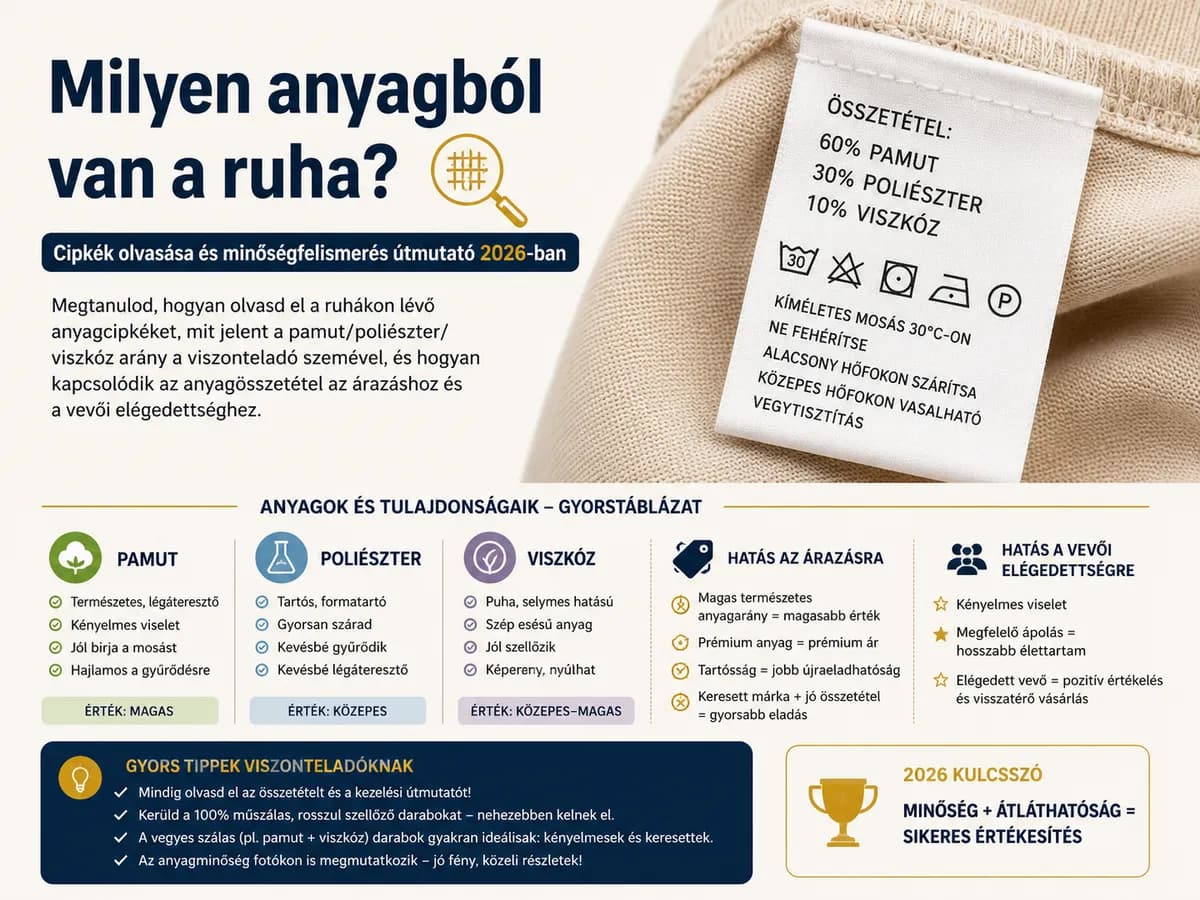
When you pick up a garment, the first instinct is to check its condition, the brand, and perhaps the size. Most beginner resellers stop there. Professional traders, however, always check one more thing: the inner label showing the fabric composition. That small, sometimes barely legible tag is where the most important information about the piece can be found.
The fabric determines how a garment wears, how it can be washed, how well it holds its shape, and – perhaps most importantly from a reseller's point of view – how much value it holds in the buyer's eyes. A 100% cotton T-shirt and a 100% polyester T-shirt represent entirely different categories, can be sold at entirely different price points, and attract entirely different types of buyers.
In this guide, we walk through all the key fabrics, show you how to read care labels, and explain why all of this matters for your business. If you'd like to go deeper into pricing, our pricing guide explains how fabric quality connects to your profit margins.
Who is this guide for?
For secondhand clothing resellers who sort and select stock and want to know which piece belongs to which price tier. Fabric knowledge is one of the best investments you can make with your time – a few hours of learning will significantly sharpen your pricing and boost customer satisfaction.
Every garment sold in the EU is required by law to display its fabric composition. This is typically found on an inner label located at the neckline, the side seam, or the waist. The label lists the materials as percentages in descending order – meaning the first material listed is present in the greatest proportion.
- Fabric composition – e.g. "80% cotton, 20% polyester". The ratio tells you which material is dominant, and that's the basis for assessing value.
- Care symbols – Symbols showing how the garment should be handled: whether it can be machine washed, at what temperature, whether it can be ironed, and whether it is dry-clean only.
- Country of manufacture – "Made in…" text. It doesn't directly determine the price, but for certain branded pieces it serves as an authenticating factor.
- Size – Some labels also include the size. If there is no separate size label, this is the only size information available.
If a label reads: "60% viscose, 35% polyamide, 5% elastane" – viscose is the dominant material. The first material listed typically defines the garment's feel, breathability, and value. That's why the quality of the first material is the most important factor when assessing a piece.
The vast majority of secondhand garments on the market are made from six or seven base materials, or blends of them. Each has its own place and value – the key is knowing what to expect from each one.
Care symbols convey in pictogram form how a garment should be handled. Your buyers will regularly ask how a particular item can be washed – and if you don't know the symbols yourself, you won't be able to explain it convincingly. This has a direct impact on buyer trust and your ratings.
Practical tip for resellers
When photographing a garment, also photograph the care label – this alone reduces the number of buyer questions and builds trust. If buyers can see from the photos that the item is machine washable at 40°C, they don't need to ask: their decision becomes that much easier.
There is a direct relationship between fabric composition and selling price. This isn't a matter of opinion – market data from Vinted and Facebook consistently shows this. Resellers who consciously sort by fabric can price more accurately and can expect higher overall revenue.
| Fabric | Pricing tier | Vinted average price (tops) | Notes |
|---|---|---|---|
| 100% cotton | High | 1,800–5,000 HUF | "100% cotton" label = a selling point |
| Cotton-elastane blend | High | 1,500–4,000 HUF | Stretch effect is a bonus |
| Linen | High | 2,000–6,000 HUF | Seasonal: peaks in summer |
| Viscose / Lyocell | Medium | 1,200–3,000 HUF | Popular in summer blouses |
| Polyester | Low | 500–1,800 HUF | Sportswear can be an exception |
| Wool (winter piece) | High (seasonal) | 3,000–12,000 HUF | Peaks in autumn and winter |
The values in the table apply to unbranded pieces in good condition. If you'd like to do a deeper pricing calculation – including cost per kilogram and profit margin per item – read our pricing guide, where we walk through the calculation with real numerical examples.
The fabric label informs you, but your hands tell you the truth. An experienced reseller knows from the first touch whether a piece is cotton or polyester, thick or thin, worn or in good shape. This knowledge can be acquired systematically.
Cotton has a matte surface, a full, substantial feel, and doesn't generate static. If you rub your hand against it, it doesn't cling. The fabric doesn't shine – if it shines, there's a synthetic component. Well-washed but otherwise good-condition cotton is slightly softer than new – this is not a flaw, it's natural aging.
Polyester is lighter than cotton, smoother, and shinier. If you twist it and let go, it quickly springs back – it has less tendency to crease. However, it doesn't breathe: press your finger against it and hold it there, and your hand warms up faster. On Vinted, buyers can usually tell the difference and will accept a lower price for it.
Real wool is slightly coarse and characteristically warm – if you touch it with your hand, your palm warms up quickly. It doesn't generate static and is springy: if you squeeze it and let go, it bounces back. It's important to check for moth holes and separating fibres – these are value-reducing factors that the fabric label won't reveal, but a visual inspection will.
Quick test
If you're unsure whether a fabric is cotton or polyester, pinch a corner of the fabric and hold it up to a strong light source (sunlight or a lamp). Cotton lets some light through but stays matte; polyester glitters and becomes noticeably brighter. If you see a two-toned shimmer, you're looking at a blend.
In the extrahasznaltruha.hu quality category system (Cream, Extra, A+, Original), fabric composition is a defining factor. If you'd like to learn more about the categories and the logic behind them, read our business launch guide, which explains the system in detail.
If you work with original bales, fabric knowledge is the foundation of sorting. The faster you can assess a piece's fabric, the more efficient your work – and the more accurate your pricing. Our Original category is designed for those who want to be involved in the sorting process.
- Pricing without a label. If someone has cut out the label – perhaps it was irritating or had worn away – don't overestimate the piece. Without a label, the fabric cannot be proven. Lower the price and note in the description that the care label is missing.
- Only looking at the first material, ignoring the blend. "60% cotton, 40% polyester" is not the same as 100% cotton. A 40% polyester content fundamentally changes the feel and the value. Don't treat it as a premium piece if the blend ratio indicates a high synthetic content.
- Confusing wool with acrylic. Acrylic (100% acrylic) can feel just as warm as wool, but is worth a fraction of the price. Always check the label before treating something as wool. Real wool will say "wool" on the label.
- The shine = quality myth. A shiny fabric does not mean premium – in fact, it often signals synthetic content. Real silk is indeed shiny, but its label will clearly state "silk" or "100% silk".
- Not photographing the label. Photographing the label for every single piece is time-consuming, but it's an investment. It increases buyer trust and your average rating, because buyers don't need to ask – they can see everything in the photos.
Reading fabric labels and identifying materials is not a complex science – but it needs to be approached systematically. A few hours of learning, handling and comparing a few dozen pieces is enough for you to automatically know the value of any piece simply by reading the label and feeling the fabric.
The 5 golden rules of fabric knowledge:
- 1. Always check the label – A 30-second investment that directly improves the accuracy of your pricing.
- 2. The first material is the most important – The order of percentages shows the dominant material, which determines the value.
- 3. Natural > synthetic, but there are exceptions – For sportswear, polyester is expected, not a disadvantage. Context matters.
- 4. Photograph the label for every piece – It reduces the number of questions, increases buyer trust, and improves your ratings.
- 5. Include the fabric's benefits in the description – "Cotton" alone isn't enough. Write: "100% cotton, breathable, skin-friendly" – this drives sales.
If you're curious about our current stock – including the Original category where you can put this knowledge to work during sorting – browse our products. If you have any questions, don't hesitate to get in touch – we're happy to help you navigate the categories and fabrics.