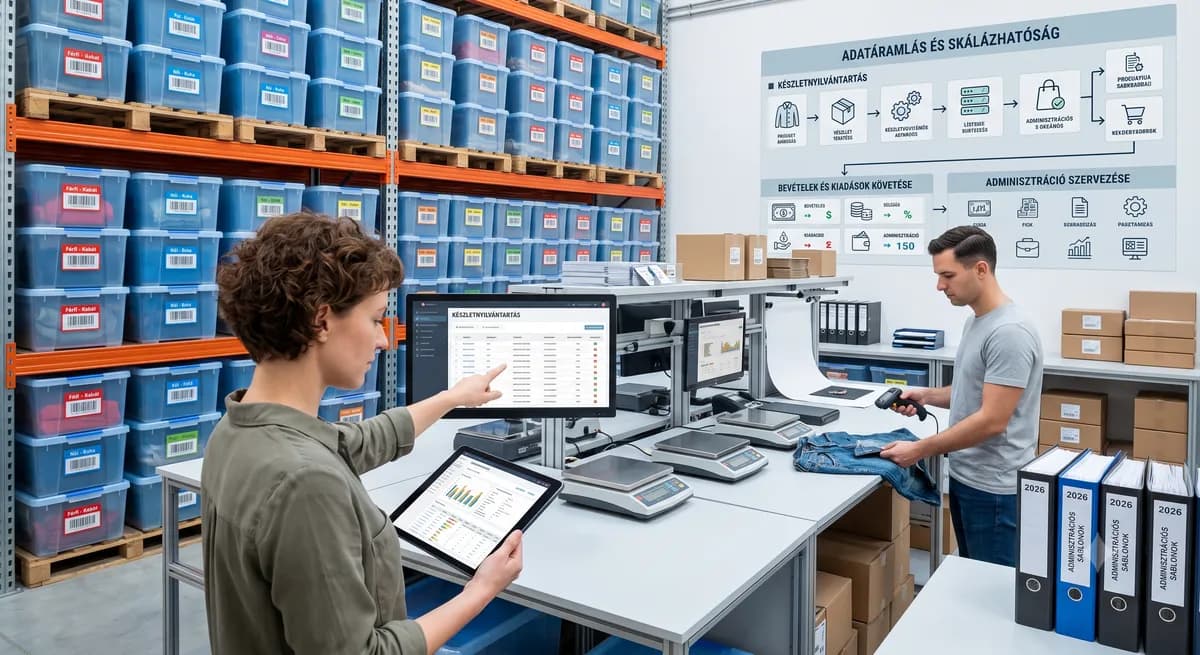
Most beginner used clothing sellers keep all their numbers in their head – and for a while this works. But as the business grows, managing by memory leads to more mistakes and missed profit. A simple system – even on paper or in a spreadsheet – can double your efficiency and make your real profit visible.
68%
of small traders keep no accurate records
2×
faster decision-making with regular data
15%
average profit improvement with regular data tracking
30 min
weekly admin with a good system
Why is Record-Keeping Essential?
Real profit becomes visible
Many sellers think they are profitable – but once all costs are included (shipping, platform fees, packaging, time), they may find very little left.
Decision support
Which bag category brought the most profit? Which platform is most effective? Without data we only guess – with data we can decide.
Tax and legal compliance
If you earn regular income, the tax authority is interested. Accurate records let you prove income and expenses – and avoid unpleasant situations.
Scalability
If you want to grow the business, a bank loan, investor, or partner will ask for exactly this: historical data, trends, and projections.
The Minimum 4 Records You Need
1
Purchase log: Date, supplier, bag type, kg, purchase price, shipping cost. This is the base for all calculations.
2
Sales log: Date, item, platform (Vinted/FB/other), sale price, platform fee deducted. Weekly summary.
3
Stock register: How much is in stock, by category, how long it's been there, estimated value. This reveals "dead stock".
4
Expense log: All other costs: packaging, internet, phone, transport, advertising. A monthly summary makes total costs visible.
Simple Excel/Google Sheets Template – How It's Structured
| Sheet name |
Columns |
Update frequency |
| Purchases |
Date | Supplier | Category | Kg | Price | Shipping | Unit cost/kg |
Every purchase |
| Sales |
Date | Item | Platform | Sale price | Fee | Net revenue |
Daily / weekly |
| Stock |
Item | Category | Qty | Cost price | Expected sale price | Age (days) |
Weekly |
| Expenses |
Date | Description | Amount | Category (marketing/shipping/other) |
Every expense |
| Monthly summary |
Revenue | Purchases | Other expenses | Gross profit | Net profit | Profit % |
Monthly |
Tip: Start with Google Sheets
Google Sheets is free, always synced (mobile + desktop), and shareable with a partner. You don't need professional accounting software – a well-built spreadsheet is enough for years. When you grow, then consider dedicated tools (e.g. invoicing software, accountant).
5 Numbers Every Seller Must Know
Gross profit %
(Revenue – Purchase cost) / Revenue × 100. Healthy: 40–60%. Shows how much you earn on purchases.
Net profit %
(Revenue – All expenses) / Revenue × 100. Healthy: 20–35%. The real profit left after all costs.
Stock turnover speed
On average, how many days does an item sit unsold? Target: under 14 days. More means a pricing or channel problem.
Average sale price
Total revenue / units sold. If this drops, you need to adjust pricing or category mix. See:
pricing guide.
Platform efficiency
How much net revenue comes from Vinted, FB Marketplace, local market? This shows where to invest more time.
7 Admin Mistakes That Eat Into Profit
1
Not including shipping costs: If you don't count postage as an expense, profit appears higher than it really is.
2
Lost invoices and receipts: For sole traders, purchase invoices may be deductible for tax purposes.
3
Not tracking dead stock: Items unsold for 30+ days tie up capital and space unnecessarily.
4
No summary: Without a weekly/monthly summary, you can't see which direction the business is heading.
5
Not categorising expenses: If you don't know where the money goes, you can't optimise.
6
Mixing personal and business expenses: This is the source of most accounting and tax problems.
7
No forward planning: If you don't know how much capital the next season needs, you may not have enough to order.
Frequently Asked Questions
Do I need to register a business for selling used clothing?
If it's regular, commercial activity (not a one-off sale), yes – for tax and legal reasons it's worth registering. Consult an accountant for your country's requirements.
Which software do you recommend for record-keeping?
For beginners: Google Sheets (free, simple). For a growing business: invoicing software + accountant combination. At a professional level: Sage, QuickBooks, Xero.
How do I calculate which bag category is the best?
Keep per-bag records: purchase price / number of items / total revenue / net profit. The comparison will show which category is most efficient.
What counts as "dead stock"?
Any item that has been with you unsold for more than 30 days. This signals that the price, photo, or category is wrong – immediate action needed.
How do I split my time between admin and selling?
Admin should be a maximum of 10–15% of your working time. 30 minutes a week is enough if done regularly – don't leave months of admin to do all at once.
What documents do I need for purchases?
Ask for an invoice or receipt for every purchase – these prove your expenses. Can be stored digitally (scan or photo). Keep for at least 5 years.
When is it worth hiring an accountant?
When your monthly net revenue exceeds €600–800, or when you've registered a business – at this point accountant assistance is worth it. Incorrect tax filing is more costly than the accountant's fee.
How do I plan next month's purchases?
Review last month's data: what sold, what remained, what you needed more of. Calculate the next order from this. Also factor in seasonal trends.
Is it worth photographing the stock?
If you have many items, yes – a photo-gallery-based record is much easier to manage visually than a text list. Mobile apps (e.g. Sortly) can help.
5 things worth remembering
1
4 core records (purchases, sales, stock, expenses) are enough for a clear business overview.
2
30 minutes/week of admin prevents months of backlog and unpleasant surprises.
3
Dead stock = frozen capital — items older than 30 days need immediate action.
4
Separate personal and business expenses – this is the foundation of everything.
5
Decide based on data — not gut feeling. This is what separates the amateur from the professional.
Looking for a regular, predictable source of stock?
Browse our bag selection – guaranteed quality categories that are easy to track and calculate.
View our products
Contact us
Related articles:
Pricing guide ·
Wholesale vs. retail ·
Seasonal stock planning