Nationwide delivery
Brand recognition – how to identify genuine branded items and price them correctly?
April 26, 2026

Brand recognition – how to identify genuine branded items and price them correctly?

Extra Használtruha Team

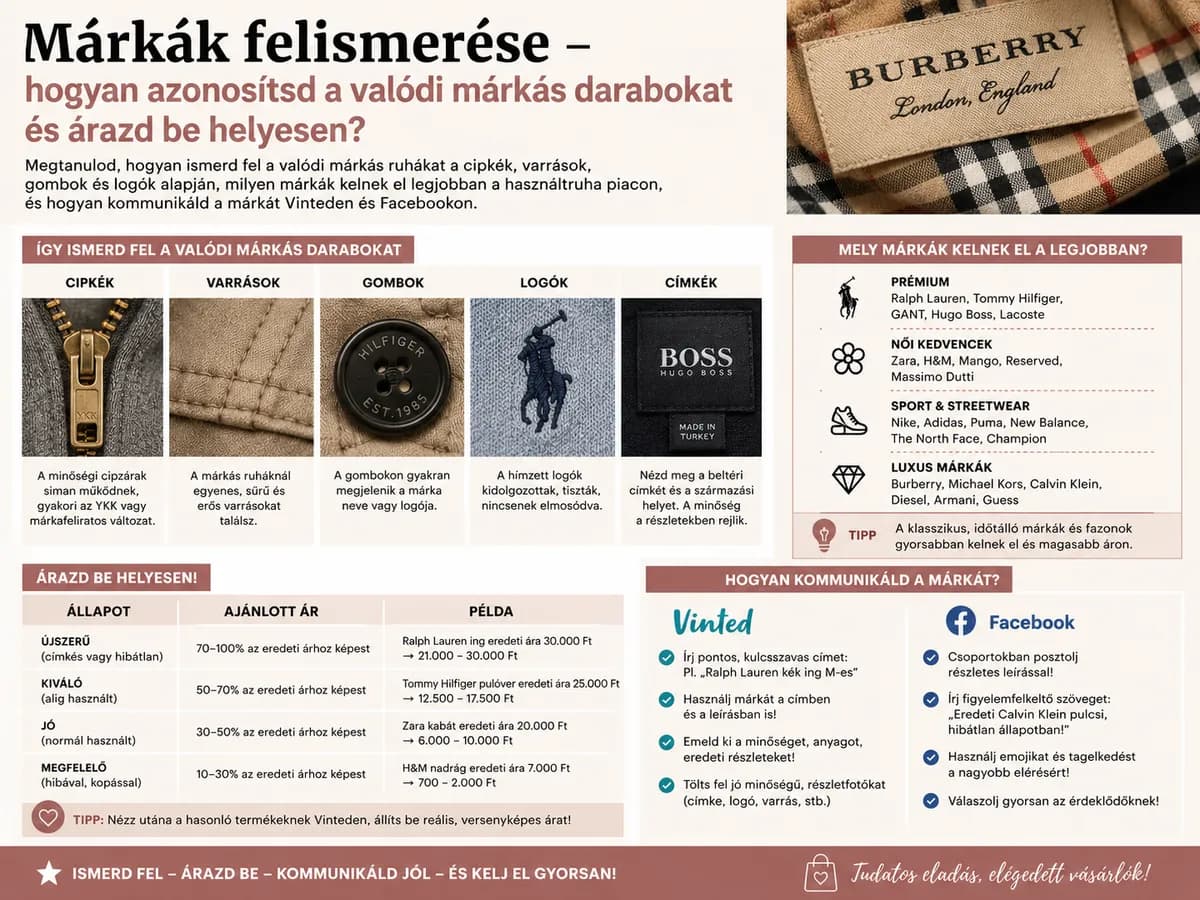
Learn how to recognise genuine branded clothing by labels, stitching, buttons and logos, which brands sell best on the second-hand market, and how to communicate the brand effectively on Vinted and Facebook.

Sales guide · April 2026

The brand is the one thing a buyer sees even before reading the product description

Think about how you search for clothes on Vinted or Facebook Marketplace. You type in: "black coat". You get a hundred results. That first visual scan takes a few seconds – photo, price, and if present: brand name. The seller who can communicate the brand right at the top of their listing immediately stands out from the crowd. Not just in search rankings – but in the buyer's mind as well.

In the second-hand clothing market, brand is one of the most powerful value-adding factors. A well-identified Nike, Levi's or Tommy Hilfiger item can sell for up to three times the price of a similarly conditioned piece from an unknown brand. But to get there, you first need to know whether you're actually dealing with a genuine branded item – and if so, how best to sell it.

In this guide we walk through how to identify genuine branded items, what to look out for with fakes, which brands sell best, and how to communicate the brand effectively in your listings. For details on the related category system, read our business start-up guide.

2–3×
Higher selling price for a known brand in the same condition
5 signs
That can identify a genuine branded item
30 sec
Enough for an experienced reseller to identify the brand
↑ price
Communicating the brand in your listing = fewer offers, faster sales

Who is this guide for?

Resellers who work with sorting and selecting second-hand stock and want to pick out branded items to sell at a higher price. It's also useful if you simply want to understand why some people charge three times as much for a similar garment – and how you can achieve the same results.

The 5 most important identification points

Recognising a genuine branded item doesn't come down to a single thing – it's a judgement based on the overall picture. By checking the five points below, the vast majority of cases will give you a clear answer as to whether you're looking at a genuine branded piece.

1. Inner labels – the first and most important sign

The inner neck label and the care/composition label are the most reliable source. On genuine branded items, the inner label is typically neat, evenly stitched and printed to a high quality. On cheap fakes, the label is only moderately accurate, with blurred lettering or uneven line spacing.

  • Print quality – On genuine brands, the text on the label is sharp, even and does not wash off. On fakes it blurs after washing.
  • Label stitching – The label is sewn in evenly and precisely. If the label is half hanging out or sewn in at an angle, that indicates poor quality.
  • Serial number / factory code – Several brands (e.g. Ralph Lauren, Hugo Boss) also print a serial number on the inner label. This is generally absent on fakes.
  • Composition label consistency – On genuine brands, the care label contains fabric composition and washing instructions in compliance with EU regulations. If the fibre breakdown by percentage is missing, that's a warning sign.
2. Stitch quality

Stitching is hard to fake – because quality requires expensive machinery and precise workmanship. On a genuine branded garment, the seams are even, tight and symmetrical. No threads are hanging loose, and the joins show precise alignment.

Genuine brand stitching
Even stitch spacing · Symmetrical layout · No loose threads · Smooth inner seams · Pattern matching at seams where patterned fabric is used
Signs of poor quality / fake
Uneven stitch spacing · Asymmetric construction · Dangling, untrimmed threads · Rough inner seams · Pattern misalignment at seams
3. Buttons, zips and hardware

The quality of the hardware is a telltale sign – precisely because cheap manufacturers cut corners here. On a genuine branded jacket, the zip will typically carry its own brand marking (e.g. YKK, Riri, or the clothing brand's own name). Buttons are heavy, uniform and fit the buttonholes well.

  • Zip – YKK is the world's largest zip manufacturer; if you see the YKK marking on the zip, you're dealing with a quality component. Importantly, it should open and close smoothly without snagging.
  • Buttons – On genuine branded items, the brand name may also appear on the back of the button. Buttons are uniform in size and sewn on consistently. If the button material looks cheap (shiny, lightweight), it generally points to a fake.
  • Buckles and metal hardware – On genuine brands, metal fittings are made from heavy metal and do not corrode. On cheap fakes, the metal surface is worn or painted and peels off easily.
4. Logo and print inspection

The logo is the area that counterfeiters get right most often – but if you know what to look for, discrepancies can still be spotted here. On genuine brands, the logo is sharply and evenly printed or precisely embroidered. On embroidered logos, the threads are taut and uniform, with no visible thread ends.

Quick logo check

Hold the embroidered logo up to a strong light source. On a genuine logo, the embroidery is even, the threads are dense and uniform. On cheap fakes, the embroidery is sparser and the base fabric threads may be visible through the stitching. For a printed logo, zoom in sharply: does it pixelate? On a genuine brand it won't.

5. Overall proportions and cut

Premium brands' patterns are based on unique and precisely defined proportions. If the collar proportions on a "Burberry" coat don't look right, or the sleeves on a "Ralph Lauren" shirt deviate from the norm – that's a clear sign of departure from the original pattern. Of course, this eye develops over time once you've seen many genuine pieces – but as a starting point, the overall impression is enough: does the item look neat and well-proportioned?

Quick brand overview – what you need to know about the best-selling brands

You don't need to know every brand. 80% of the items circulating on the second-hand market come from a few dozen brands – and solid knowledge of these is enough to give you a competitive edge.

Nike / Adidas / Puma
Best-selling category
The three major sportswear brands – sellable in almost any condition, but prices vary widely. Vintage Nike (1980s–90s) achieves premium prices; newer pieces move at standard market rates. Identification: embroidered/printed logo, brand marking on zip, inner label showing "Nike Inc." or similar manufacturer.
Levi's
Denim market staple brand
The most widespread premium denim on the second-hand market. Identification signs: leather patch at the rear waistband, the "batwing" stitch (V-shape) or embroidered text on the back pocket, rivets at stress points, customs number on the inner label. The Levi's 501 and 505 styles are particularly sought-after pieces.
Tommy Hilfiger / Ralph Lauren
Premium segment
Both brands represent the preppy/classic elegant style. Characteristics of genuine pieces: neat, fine embroidery (not printed logos), quality fabric (cotton, linen), well-sewn collars. Fakes are rarer than with sportswear brands but do occur – mostly copies.
Zara / H&M / Mango
High-volume mid-range segment
Fast fashion brands are the most common on Vinted. In good condition and a current style they are sellable, but at lower prices than premium brands. Counterfeiting these is rare because it simply isn't worth it – the genuine items are cheap. For these, condition and style are what matters most.
The North Face / Columbia / Patagonia
Outdoor premium – strong demand
Premium outdoor brands enjoy strong demand on the second-hand market. Identifying genuine pieces: quality zips (YKK), inner label matching the expected fabric (Gore-Tex, DryFit), brand's own repair tape on the zip. These brands are increasingly searched for intentionally on Vinted.
Hugo Boss / Calvin Klein / Lacoste
Business premium – high prices
Semi-premium/premium business brands achieve outstandingly high prices on Vinted. Calvin Klein underwear and jeans are especially sought after. Lacoste polo shirts are identified by the small crocodile embroidery – this can be faked, so check the label too. Hugo Boss suits and coats represent the most profitable segment.
Counterfeits – what to look for and how to avoid buyer disputes

Counterfeits don't appear as your problem in a sale – they appear as your buyer's problem if you sell a fake as genuine. This represents a serious risk of returns and negative reviews. That's why it's important to know what to watch out for.

Signs of a counterfeit – watch out for these

Unrealistically low price relative to the original item – if the price is logically too cheap for what the item should cost, be suspicious. Label quality differs – blurred printing, inconsistent text, label curling unevenly. Asymmetric logo – embroidery is rough, print is not sharp. Mismatched care label – e.g. a "Nike"-labelled garment with a "100% polyester, made in China" care label is suspicious, but a missing care label is even more suspicious. Poor zip – not YKK, snags, or breaks on the first opening.

What should you do if you're unsure?

If you're not certain you're dealing with a genuine branded item, don't sell it as one. There are two options: either note in the description that "authenticity cannot be verified, purchase at buyer's own risk", and price it lower – or simply don't highlight the brand at all, and price it based on style. This approach is transparent and buyer-friendly – it's better to receive a lower price than to handle a return.

Brand and price – the direct connection

When it comes to pricing, brand is one of the strongest pricing factors. For a coat of equal quality, the presence of a brand can cause a 200–300% price difference on Vinted. This isn't unfair – buyers consciously pay more for a known brand because they identify with it, associate it with quality, and because they too want to resell or wear something branded.

Category Typical Vinted price (coat) Notes
Unknown brand, good condition 1,500–3,000 HUF Depends on quality
Zara / H&M / Mango, good condition 2,500–5,000 HUF Depends on style and seasonality
Tommy Hilfiger / Ralph Lauren 4,000–10,000 HUF Depends on type and condition
The North Face / Columbia 6,000–18,000 HUF Technical outerwear especially sought after
Hugo Boss / Calvin Klein 8,000–25,000 HUF Suits, coats – premium segment

The prices above are indicative and vary depending on condition, type and time of year. For precise pricing calculations, we recommend our pricing guide, which also covers how to calculate your margin.

How to communicate the brand on Vinted and Facebook

Identifying the brand is only half the work. The other half is communicating it effectively in your listing. Many sellers neglect this – and as a result sell branded items for less than they should.

On Vinted – searchability and trust
On Vinted, the brand name is one of the most important keywords. Always put the brand first in the listing title field: "Nike running jacket, size S" – not "running jacket, Nike". The search algorithm weights the beginning of the title. In the description, repeat the brand and add the fabric: "genuine Nike Dri-FIT sports casual jacket, good condition, inner label present". To verify authenticity, upload a photo of the care label and inner logo – this alone reduces haggling.
On Facebook – instant trust
On Facebook, buyers make quicker decisions – they read less, but they judge the first image instantly. If the logo is visible in the listing's first photo itself (e.g. the front of the jacket), that's the best visual trust signal. Keep the description brief: "Genuine Levi's 501, 32/32, excellent condition, 3,500 HUF". No need for an essay – just the fact, the size and the price.
Footwear follows different rules
For branded footwear, a reliable photo series is especially important. Photograph the sole (brand marking), the insole (also typically brand-marked), the side (logo) and the size marking. If you're selling Nike, Adidas, Vans, Converse or New Balance shoes, these photos alone verify authenticity – and reduce haggling. For more detail on branded footwear, browse our shoe category.
Frequently Asked Questions (FAQ)
How do I quickly tell whether an item is branded?
Check the inner label – that's the first and most reliable sign. If a known brand name appears there, check the quality of the stitching and zips. If both check out, you're very likely looking at a genuine item. From experience: 30 seconds is enough for an initial assessment if you do this regularly.
What should I do if I suspect a counterfeit?
Don't sell it as genuine. You have two options: either note in the description that "authenticity cannot be verified, purchase at buyer's own risk" and sell it at a lower price – or simply don't highlight the brand and price it based on style. Selling a counterfeit as genuine can cause both legal and ethical problems.
Which brands sell best on the second-hand market?
In sportswear: Nike, Adidas, Under Armour. For denim: Levi's, Lee, Wrangler. Premium/classic: Tommy Hilfiger, Ralph Lauren, Lacoste. Outdoor: The North Face, Columbia, Patagonia. Luxury: Hugo Boss, Calvin Klein. These brands are in demand every season – if you're sorting stock, give these special attention.
What is the most reliable identification sign for Levi's?
The surest Levi's identifiers are: the leather patch at the rear waistband, the characteristic V-stitch on the back pocket (a well-proportioned V-shape even without the "batwing" text), rivets at stress points, and the "Levi Strauss & Co." text on the care label. If all of these are present, you're almost certainly looking at a genuine piece.
How do I tell a genuine Nike from a counterfeit?
For Nike, check the care label: it should show "Nike, Inc." or "Nike (USA)" as the manufacturer. The Swoosh logo must be sharp and symmetrical. On embroidered logos, the threads are taut and uniform. Nike's name typically also appears on genuine zips. The fabric is generally higher quality – functional textiles marked DRI-FIT, Therma-FIT, etc.
Does brand make a big difference when pricing?
Yes, it's one of the strongest pricing factors. For a coat of equal quality and condition, the Nike or The North Face brand can result in a 200–300% price difference compared to an unknown brand. That's why it's worth paying special attention to branded items during sorting, and selling them separately at a higher price.
How do I highlight the brand in a Vinted description?
Put the brand at the start of the title: "Levi's 501 jeans, 32/32" – not "Jeans, Levi's". In the description, include the fabric and identifying features: "genuine Levi's 501 with inner label, rivets, 100% cotton". Upload photos of the label and patch – these are your proof. Finally, set a realistic price: continuously check what similar branded items in similar condition are selling for on Vinted, and position your price accordingly.
What about outlet items?
Outlet items are genuine branded products – but typically priced lower than regular retail pieces, because outlet goods are generally items that didn't make the main collection or were produced with minor quality deviations. If the inner label says "outlet", mention this in your description. Buyers generally accept it – in fact, many actively look for outlet pieces because they know they're getting a genuine brand at a lower price.
How do I set a starting price for branded items?
First step: search Vinted for the same type (brand + type + size). See what similar items are priced at and what condition they're in. Then position your own item: if yours is in better condition, ask a little more; if similar, price in the middle of the market. Build in room to negotiate: if you expect 4,000 HUF, list it at 4,500 HUF.
Where is the best place to sell branded items?
Vinted is the number-one platform for branded items in Hungary and across Europe – buyers actively search for brands and are willing to pay a premium. Facebook Marketplace is also a good option, especially for local sales. If you have a regular, high volume of branded stock, your own webshop is worth considering. For a comparison of platforms, read our article on online platforms.
Summary – brand knowledge is an investment

Identifying brands and communicating them effectively is one of the best investments of your time as a reseller. It requires no special tools or capital – only awareness and consistent attention. After a few weeks of sorting and writing listings, the routine sets in, and by the fifth or tenth Levi's you'll recognise it automatically.

The 5 golden rules of brand recognition:

  • 1. Always check the inner label – This is the first and most reliable identification point. If the brand is there, check the stitching too.
  • 2. Check the stitching and hardware – The zip, buttons and stitch quality together give you the full picture. If anything doesn't add up, be cautious.
  • 3. If you're unsure, don't sell it as genuine – The lower price you receive is better than a return, a dispute and a bad review.
  • 4. Photograph all identification points – Label, logo, patch, zip, buttons: these photos verify authenticity and reduce haggling.
  • 5. Put the brand as the first word in your title – Both on Vinted and Facebook, this is the most important position from the perspective of search logic and first impressions.

If you'd like to see what branded items are currently available in our stock, browse our products. If you have questions about the stock or would like to order with a Video Check guarantee, get in touch – we're happy to help.

Cookie Preferences

Our website uses cookies to improve your experience and for statistical purposes. You can choose which cookies you allow. Privacy Policy.

Brand recognition – how to identify genuine branded items and price them correctly? | Extra Second Hand Wholesale