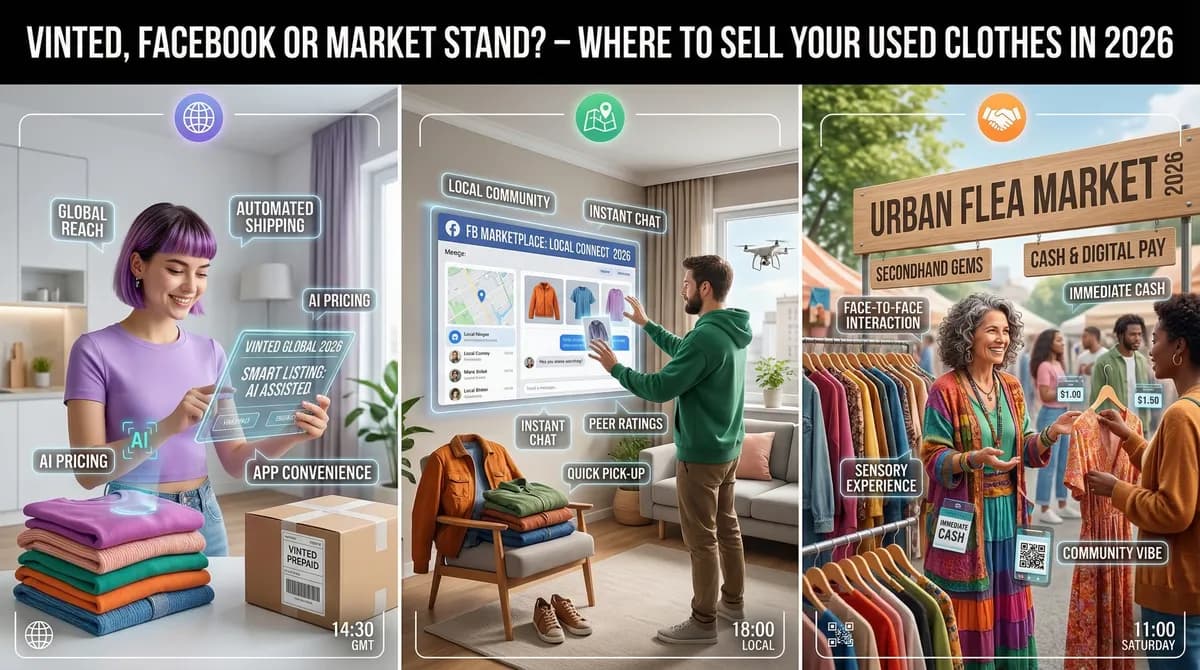
You have a 20 kg lot of hand-picked Cream category items in your warehouse. Great quality, fashionable pieces, impeccable condition. But the question isn't what you're selling – it's where you're selling it. The same skirt goes for the equivalent of €5 at the local flea market, €12 on Facebook Marketplace, and €20 on Vinted – with the right photo and the right description.
Platform strategy is one of the most underrated elements of modern second-hand trading. Many sellers try to move the same goods through one channel – then wonder why results don't match expectations. In this article, we'll show you which platform suits which category, which target audience, and which stage of your reseller journey.
If you haven't read our previous article on how to start a successful second-hand business, we recommend starting there – it covers sourcing, quality categories and the Video Check guarantee. This article builds on that: now we focus on the selling side.
Who is this guide for?
Resellers and small retailers who already buy from second-hand wholesalers but aren't sure they're using the best channel. Beginners who are planning their first order and want to know in advance where they'll sell their goods.
The second-hand fashion industry is no longer just a trend – it's a genuine industry shift. According to ThredUp's annual resale report, the global second-hand clothing market will exceed $200 billion in 2026, growing five times faster than traditional retail. Three forces drive this boom: price consciousness, demand for sustainability, and the mass adoption of online platforms.
Hungary is actively part of this trend. Vinted launched its stronger push in the Hungarian market in 2022 and now has hundreds of thousands of active users. Facebook Marketplace also generates enormous traffic – especially in rural and smaller urban areas where personal pickup is easier than shipping. Flea markets and local bazaars haven't disappeared either: people are increasingly consciously seeking quality second-hand clothes in person.
Professional second-hand traders don't rely on a single platform. In a well-built strategy, Cream category items land on Vinted (high price, price-willing audience), Extra pieces run simultaneously on Facebook and Vinted, A+ items move quickly at flea market volumes, and the sorted content from Original bales gets channelled to the right outlet. This not only maximises profit – it reduces the risk of items getting stuck.
💡 Key insight
Successful resellers use an average of 2–3 channels in parallel. The least successful traders (90%) use only one platform – and typically the most convenient one for them, not the most profitable.
With over 80 million registered users across Europe in 2026, Vinted is one of the fastest-growing second-hand platforms on the continent. In Hungary, the number of active users grows year on year – and more and more of them are conscious, quality-seeking shoppers willing to pay for condition and brand.
- Large buyer audience – A massive, actively browsing community with plenty of impulse buyers.
- Built-in payment system – Vinted Pay: the buyer pays, you just ship the package. No bank transfers, no delays.
- Integrated shipping – Partner agreements with multiple couriers at discounted rates.
- No seller fee – Sellers pay no platform commission (the buyer pays a small protection fee).
- Search algorithm – Active profiles and frequent uploads get better ranking.
- Strong competition – There are many listings; price competition is fierce.
- Quality expectations – Vinted buyers like to negotiate and expect detailed descriptions with many photos.
- Time-consuming per item – Every item must be uploaded, photographed and described individually.
Upload in bulk
The algorithm rewards active uploaders. Try to add 10–20 new items per week.
Brand + condition first
Buyers filter by brand and condition. Always fill these fields accurately.
Leave room to negotiate
Price 10–15% higher than your minimum. Buyers love to negotiate.
Reply fast
Quick responses and good reviews build profile credibility. 5 stars = more buyers.
If you also sell shoes, Vinted has huge demand for quality second-hand footwear. Our used shoe wholesale range includes the most popular items for Vinted.
Facebook Marketplace is one of Hungary's most visited online second-hand platforms, and for local sales it's unbeatable. No packaging, no couriers – the buyer comes to you, picks up in person, pays cash. Simple, fast, zero platform fee.
- Zero platform fee – Facebook charges no seller commission.
- Local audience – Fast sales, personal pickup, no need to ship.
- Group selling – You can advertise simultaneously in dozens of local bazaar groups.
- Trust building – Buyers see the seller's profile; familiar faces appear.
- Haggling – Facebook buyers negotiate more aggressively than Vinted users.
- Reliability – "I'll come pick it up" messages followed by silence are unfortunately common.
- Lower prices – Premium pricing is harder to achieve than on Vinted.
✓ Practical tip
If an item doesn't sell on Facebook within 3 days, don't delete it – move it to Vinted at a higher price, or refresh the original listing with new photos. A "refresh" has the same algorithmic effect as a new upload.
Despite online dominance, a physical selling point – whether a flea market, weekend bazaar or permanent shop – remains one of the most effective methods for fast stock turnover. The buyer touches the item, decides on the spot, and pays immediately. No returns, no week-long waits, no SMS coordination.
- Immediate cash flow – You receive money at the moment of sale.
- Bulk buying in one deal – One customer takes 5–10 pieces at once.
- Zero return risk – The buyer sees, touches, and decides on the spot.
- Fast stock rotation – One good market day can outperform a week of online activity.
- Repeat customers – Personal contact builds loyalty.
- Stand rental cost – A good market stand can cost from a few hundred to several thousand forints per day.
- Physical presence required – Not easily scalable; if you're not there, there's no sale.
- Seasonality and weather – Outdoor markets draw less traffic in cold or rainy conditions.
Beyond a certain sales volume, almost every successful second-hand trader arrives at the same question: Should I open my own shop? The answer is usually yes – but not for everyone, and not right away.
- Stable monthly turnover – If you're already selling 200–300 items per month, a webshop investment will pay off.
- Returning customer base – If buyers keep coming back, it's better to keep them on your own platform than on a third-party app.
- Brand-building ambition – Turning your shop name into a brand requires your own domain, webshop and newsletter.
- Higher price point – A dedicated webshop feels more premium and justifies higher prices.
- SEO potential – Over years you can build organic Google traffic that no platform can replicate.
To understand why resellers trust us year after year, visit our page – there you'll see how a stable supply chain is built.
| Platform | Fee | Ideal category | Reach | Recommended level |
|---|---|---|---|---|
| Vinted | 0% (seller) | 💎 Cream, ⭐ Extra | Large – 80M+ EU | All levels |
| Facebook Marketplace | 0% | 🔵 A+, 📦 Original mix | Local – large HU reach | Beginner – intermediate |
| Market stall | Fixed stand rent | ⭐ Extra, 🔵 A+ mix | Local – physical traffic | Intermediate – pro |
| Own webshop | Hosting + dev | 💎 Cream, ⭐ Extra | Own – SEO based | Pro level |
Whatever platform you choose, one thing is universal: the photo is the first impression. A good photo alone isn't enough – but a bad photo will definitely kill the sale. The buyer can't feel the fabric or try on the item: they decide from the image.
Natural light
By a window, during the day. Avoid yellow indoor light – it distorts colours.
Neutral background
White wall, grey cardboard. On a mannequin or hanger is best – shows the shape of the garment.
Detail shots
Brand label, zip, collar close-up. These sell the quality and reduce returns.
Size and condition
Always state the label size + actual measurements. Reduces misunderstandings.
If you get the chance, check out our Video Check videos – they show what premium product presentation looks like in a real environment. What we do in our pre-purchase previews, you can replicate on your sales pages.
💡 Platform-specific tip
On Vinted, the first photo is what appears in list view – that image makes or breaks the click-through. Always put the best angle first. On Facebook, the text is equally important: a personal, direct description performs far better than a cold template.
Seasonality in second-hand trading isn't as big a constraint as in new fashion – but ignoring it isn't wise either. The question isn't what you buy now – it's when you sell different types of items and on which channel.
Current sale items and seasonal highlights can be found in the product catalogue. For shipping questions, visit our shipping page for detailed conditions.
Successful second-hand selling isn't a question of one platform – it's a question of a deliberately built mix. Vinted brings the premium price, Facebook brings fast turnover, the market brings immediate cash flow, and your own webshop builds long-term brand equity.
Recommended platform mix by level:
- Beginner (months 1–3): Facebook Marketplace + Facebook Groups. Learn the basics, get to know your audience.
- Intermediate (months 3–12): Vinted + Facebook in parallel. Cream and Extra to Vinted, A+ and Original mix to Facebook.
- Pro (12 months+): Vinted + Facebook + market stall + own webshop. More channels mean less dependency on any single platform's fluctuations.
- Common foundation everywhere: Quality photos, accurate descriptions, fast communication, and reliable stock sourcing.
For that last point – reliable stock sourcing – we're here. Browse our current stock, or if you have questions about categories, shipping, or timing – get in touch. We'll help you find the combination that earns the most with the least risk.