There is a moment every beginner second-hand reseller experiences sooner or later: you search for an item in your own stock – and you cannot find it. You know it is there somewhere, you saw it two days ago, but it has vanished among the piles of clothes. Meanwhile the buyer is already messaging you, and you frantically rummage through the heaps, only to write back in embarrassment: "I'm sorry, this item is no longer available."
That moment is not about bad luck. It is about the absence of a system.
Disorder in a reseller's life takes its toll slowly but surely. Lost items, minutes spent searching, crumpled clothes that can no longer be photographed properly. A bad photo attracts fewer buyers, a lost item means direct revenue loss, and slow sorting means spending hours on work that a good system would let you complete in 20 minutes. These are small losses – but they add up.
The good news: you do not need a dedicated storage room, industrial shelving, or a serious investment. A small but well-thought-out system works even in a wardrobe-sized corner – and it dramatically changes how you feel while doing your work. In this article we walk through step by step how to set up a professional storage system at home so you can sort faster, take more professional photos, and never again lose that jacket a buyer has already paid for.
3 zones
the foundation of an efficient storage system
£0
a basic system can be set up for free
50%
time savings with an organised storage
2×
faster sorting with a proper system
Where should you store your stock? – The basics of location
Before buying any shelf or box, the most important question is: where will your storage be? The location determines all your other decisions – and the wrong location can ruin your goods before they reach a single buyer.
The best solution in a home setting is a corner of a room, a separate wardrobe, or a dry, interior storage cupboard. If you plan to use a garage or basement, you need to be very careful – more on those below.
The three mandatory conditions
Dry
Moisture is your enemy. A mouldy garment is unsellable, and mould can spread to other items. Relative humidity should not exceed 60%. If in doubt, buy an inexpensive humidity meter.
Dark
UV light fades fabric – especially darker and brighter colours. Do not place clothes directly next to a window, and if necessary cover them with a sheet or blanket.
Ventilated
A cramped space without ventilation accelerates mould growth and the development of unpleasant odours. Allow air to circulate through stored items – tightly sealed plastic bags are problematic over the long term.
What to avoid – unsuitable locations
Damp basement: one of the most common mistakes. A basement seems like a cheap and convenient solution, but if it is not specifically dry and internally ventilated, it will ruin your goods. A single mouldy bale is enough to cause a significant financial loss.
Storing in a car: many people use the car boot temporarily – this is acceptable for a few days, but over a longer period the temperature swings (which can reach 60–70°C in summer) and moisture cause permanent damage to the fabric.
Damp garage: a similar problem to the basement. If the garage is unheated in winter and humid in summer, it is not suitable for storing clothes over longer periods.
TIP
If you are unsure about the humidity level of a room, place a small bowl of baking soda or an activated charcoal dehumidifier inside – both are inexpensive and effectively absorb moisture.
The 3-zone storage system – the foundation that changes everything
If you learn one thing from this article, let it be this: you must physically separate items with different statuses. This single rule eliminates chaotic rummaging through stock, accidentally re-selling sold items, and the "I'm sure it's somewhere" feeling.
The essence of the 3-zone system: every garment can only ever be in one place – and its location tells you what status it is in.
Zone 1
Incoming goods
Unsorted bales, unopened packages. On the floor, on a pallet, or in a large container.
Zone 2
Ready for sale
Sorted, clean, photographed items. Organised by category, on a rail or shelf.
Zone 3
Sold / awaiting packing
Completed orders, sealed and labelled packages. A smaller area is sufficient.
Zone 1 – Incoming goods: the sorting antechamber
Everything you have not yet opened and inspected goes here. There does not need to be order in the incoming zone – that is precisely the point. A large plastic container, a pallet on the floor, or even just a defined corner is enough. The key is that it is visually separated from already-processed goods.
When a bale arrives, it goes here. Until you sort it, it stays here – and it never enters the ready-for-sale zone without you actually having gone through it.
Zone 2 – Ready for sale: the heartbeat
This is the most important area of your storage – this is where all your money is. Only items you have already inspected, photographed, and listed on a platform can enter here. Categorisation is key:
Hanging items (jackets, tops, dresses): put them on a rail with hangers. Never fold them for extended periods – they will crease, and it will show in the photos. If an item fits on a hanger, hang it!
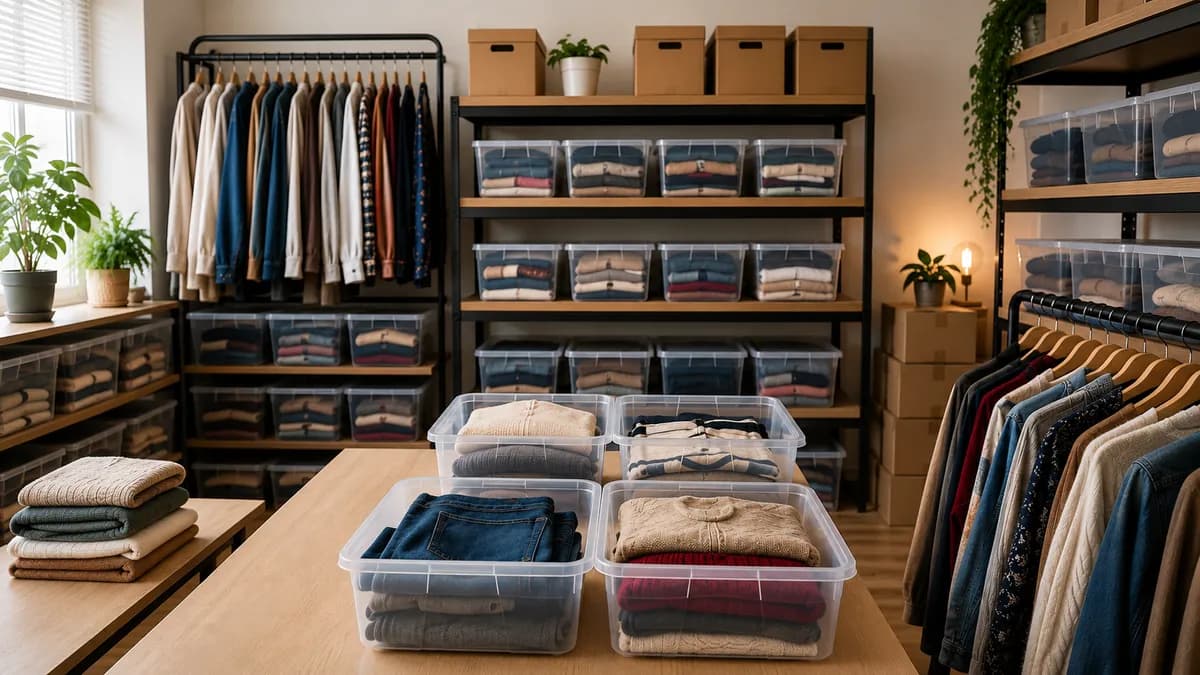
Folded items (T-shirts, trousers, underwear): on a shelf or in transparent storage boxes, organised by category. One box = one category. Write on it with a marker or attach a label.
Shoes: in pairs, each pair kept together. On a shoe rack, in a box, or in a paper bag – but always by pair, never jumbled together.
Zone 3 – Sold, awaiting packing: the island of completed orders
As soon as someone buys an item, move it to Zone 3 immediately. Do not leave it in the ready-for-sale area, as this is the most common source of double-selling and lost orders. Zone 3 can be a simple box, a basket, or a shelf corner – but it must be separated, and everything that enters it should already be packed.
TIP
If your home is small, you can implement the 3 zones using 3 different coloured marker tapes on the floor – they do not need to be physically separated by walls, a visual boundary is enough.
Furniture and tools – what do you actually need?
Most beginners think they need expensive storage furniture. This is a misconception. For the first six months, almost everything can be solved with free or very cheap tools. What matters is not the quality of the furniture but the consistent use of the system.
The basic equipment
Rail + hangers: this is the absolute minimum. The IKEA MULIG rail is very affordable, and similar rails from Decathlon or Action are comparably priced. Buy uniform hangers to go with the rail – mismatched hangers make things look chaotic and are harder to organise. 50 slim hangers cost very little.
Open shelving vs. closed wardrobe: open shelving (e.g. IKEA KALLAX) is better because everything is immediately visible – no door to open, no searching. A closed wardrobe is neater and dust-proof, but in storage the speed of access is more important.
Transparent storage boxes: the most useful investment. If you can see what is in the box, you do not have to open it. You do not need to buy expensive ones – the transparent boxes from IKEA or similar stores work perfectly.
Shoe rack: a dedicated shoe rack is best for shoes. If you do not have one, an open cardboard box works as a temporary solution – the key is that each pair stays together.
Estimated investment levels
£0 – Zero level
Existing wardrobe, shopping bags for zone separation, adhesive tape on the floor. Perfectly suitable for the first 1–2 bales.
~£15 – Basic level
Rail + uniform hangers. Immediately gives a more professional appearance, and the rail can even be hung on a door.
~£50 – Intermediate
Rail + shelving unit (KALLAX) + transparent boxes + shoe rack. A stable system for handling 3–5 bales simultaneously.
~£100 – Professional
Double rail system, full shelving wall, dedicated packing table, vacuum bags for seasonal storage. A serious, scalable setup.
GOLDEN TIP
Do not buy expensive storage furniture in the first few months. Start cheap, improvise – and only invest more seriously when you can see which zone needs expanding. A well-functioning improvised system is far better than an expensive but poorly organised storage.
Sorting and categorising – how to do it efficiently
Sorting is the point where you can gain or lose the most with your time. A well-thought-out sorting process can be completed in half the time – and the result is a stock where every item is easy to find and immediately ready for sale.
The sorting process step by step
1
Unpacking and quick condition check
Open the bale and quickly run through each item: is there a hole, stain, broken zip, or unpleasant smell? This stage takes 2–3 seconds per item – do not linger, this is not the detailed inspection, just the rough filter.
2
Separation by category
Throw everything into the appropriate pile: tops, trousers, jackets, shoes, accessories. First just into heaps – then within those by gender (women's/men's/unisex) and size.
3
Labelling
Every item needs some kind of label. For hanging items, a tag on the hanger (category + size). For shoes, the size written on the sole with a marker. For boxed items, tape on the box.
4
Photography and listing
The sorted, labelled item goes to the photography corner – more on that in the next chapter. After photographing it moves to Zone 2, the ready-for-sale area.
Categorisation and record keeping
The simplest categorisation scheme we see among home resellers: gender + type + size. For example: "Women's top – S/M", "Men's trousers – L", "Children's jacket – age 6". These three dimensions are enough to find any item in your stock within 30 seconds.
You do not need expensive software for record keeping. A simple spreadsheet where you note when you ordered, how much you paid, how many items arrived, and what has sold is enough to keep an overview of your business. If you prefer an app, the free versions of SORTLY or Photo Catalog are good for getting started.
TIP
Do not overcomplicate it. Many beginners spend weeks building a perfect system – while the clothes sit unsold. Start simple: 3 boxes + a rail + a marker + labels. That is already a perfect system.
Seasonal storage – what should be in stock and when?
Seasonal stock management is an underrated aspect that causes unnecessary space usage and lost revenue for many resellers. The principle is simple: what cannot be sold right now should not be taking up space in the active storage.
Active season: during this time the items of that season should be within easy reach, on the rail or on the most accessible shelf. Off-season items only take up space and get in the way.
Off-season: put them away, but not crumpled. Vacuum bags are the ideal solution for winter jackets – the garment can be compressed to a fraction of its size, the bag can be sealed, and the item will not crease, go mouldy, or pick up other smells. A good quality vacuum bag is very affordable per item.
Important: do not pack off-season items mixed together. One box/bag = one category. Write on it with a marker: "Winter jackets – L/XL" or "Summer dresses – S/M". That way you do not have to unpack everything when you are looking for something.
TIP
Bring out the items for the upcoming season from off-season storage 6 weeks before the season starts. This gives you time to tidy them up, reorder if necessary, and have your shelves fully stocked at the start of the season.
Setting up a photography corner – professional photos with minimal investment
The photo is what sells the garment – especially when selling online. A good photo is the cheapest marketing you will ever do, while a bad photo leaves even the best item unsold. Consistent, professional-looking images also build trust: once buyers get used to your "style", they come back.
The good news: you do not need a studio or expensive equipment for an excellent photography corner. What you actually need:
Rail + hanger
Most garments are best photographed on a hanger – this shows the cut. The same rail you use in your storage works perfectly.
White wall or sheet
A plain, neutral background highlights everything. A white sheet works well – and if you prefer, you do not have to keep it hung up permanently.
Natural light
Natural light flooding in from a window is the best light source – and it is free. Position your clothing rail so the window lights from the side or slightly from the front.
If there is not enough natural light (cloudy weather, poorly oriented flat), an inexpensive IKEA spotlight or a simple LED panel is a suitable solution. You do not need a professional softbox – just even, white light.
The most important tip: always photograph from the same spot at the same height. This makes your images consistent, and buyers will recognise your "style" at a glance – which builds trust. If you are curious about pricing today, also read our second-hand clothing pricing guide.
Packing station – one table that brings order
Packing is the last point where things can go wrong – and where a good system saves you from rushing. You do not need a large area: a table or even a corner of a kitchen worktop is sufficient, as long as all necessary materials are within reach.
What should be at the packing station?
1
Mailers / envelopes – multiple sizes
A good quality courier mailer is sufficient for T-shirts and folded tops. Buy larger bags or boxes for jackets and shoes. Always have 3–4 sizes of mailers on hand.
2
Packing tape – strong, packaging-grade
Do not scrimp on tape – a package that opens not only causes inconvenience but makes the buyer feel you put no care into the shipment.
3
Bubble wrap roll – for fragile shoes
For shoes and more delicate items, a layer of bubble wrap prevents deformation. Roll form is the cheapest – buy one roll, it lasts a long time.
Box vs. mailer: send T-shirts and loose tops in a mailer without hesitation – it is cheaper and smaller. Shoes, jackets, and more delicate items are better in a box – the shoe does not deform, the jacket does not crumple before delivery.
TIP
Buy a month's worth of packing materials in advance – ordering online works out significantly cheaper than buying individually in a shop. A pack of 100 mailers is typically 30–40% cheaper than buying them one at a time.
The 7 most common storage mistakes – and how to avoid them
Almost every beginner reseller makes these mistakes at least once. The list below will help you avoid them.
1
Storing in a damp location
Mould spreads silently, and by the time you notice it an entire bale may be ruined. This is the most serious and most common mistake – it causes total revenue loss and cannot be fixed. If the location is questionable, measure the humidity!
2
Mixing unsorted and sorted goods
If unprocessed bales are mixed with items already photographed and ready for sale, chaos is guaranteed. The 3-zone system eliminates this entirely.
3
No separate zone for packing
If completed orders are not physically separated, you may accidentally re-list them, lose them, or mix them up with another buyer's package.
4
Stock scattered across too many places
If half the stock is in the bedroom, a quarter in the kitchen, and a quarter in the car, you will never find anything quickly. Keep all stock in one place, even if that place is small.
5
Storing shoes jumbled, without pairs
A missing shoe makes an otherwise perfect pair unsellable. Always store shoes in pairs – tie them together or put each pair in its own bag.
6
Not labelling stored boxes
An unlabelled box is always a mystery. After 5 boxes you no longer remember what is in any of them. Every box should have at minimum one line: category + size + optionally season.
7
Packing folded items in a crumpled heap
If you squash "folded" items into a compressed pile, they will not look good when taken out – you either lose time ironing or end up photographing crumpled items, which reduces their saleability.
Frequently asked questions about storage
How much space does a 50 kg bale require?
A compressed 50 kg bale before unpacking takes up roughly 60×60×80 cm. After unpacking and sorting, on hangers it fits onto approximately 1–1.5 metres of clothing rail, plus 2–3 boxes of folded items. A corner of a room or a wardrobe is sufficient for this.
What if I don't have a separate room for storage?
A separate room is not necessary – a well-defined corner, a wardrobe, or even a large cupboard is enough. The key is the physical separation of zones, not the size. Many people successfully run a small storage system in the corner of a bedroom.
What should I pack winter jackets in?
The best solution is a vacuum bag – jackets can be compressed to a fraction of their size, and the bag seals them airtight from moisture and odours. If you do not have a vacuum bag, a large, dry cardboard box is also suitable – but do not seal it completely so some air can circulate.
How do we prevent mould?
A dry, ventilated location is the foundation. In addition, place an activated charcoal or baking soda dehumidifier near stored items. Avoid completely sealed, airless containers over long periods – clothes need to "breathe". Ventilate regularly and monitor humidity (maximum 60%).
Is it worth using inventory management software?
For the first 6–12 months it is probably not necessary – a well-maintained spreadsheet is sufficient. If you are already processing bales weekly and have more than 200–300 active items in stock, it is worth trying SORTLY or a similar free app. Paid solutions only pay off at a larger scale.
How do I keep track of what is in my stock?
The simplest method: a spreadsheet where you record the order date, bale type, price, number of items received, and what you have sold. That is enough to see at any time what remains. If you sell online, the platform also tracks your sales – take that into account too.
How do I store shoes if I don't have a shoe rack?
The simplest free solution: put each pair in a separate paper bag or shoebox and write the size on it with a marker. Paper bags can be stacked, they do not crush the shoe, and the labelling means you instantly know what you are looking for. If you need to expand, an inexpensive wire shoe rack is very affordable.
What lighting should the photography corner have?
The best option is natural light coming from the side or slightly from the front through a window – it gives good diffused light even on cloudy days. If this is insufficient, an inexpensive IKEA spotlight or a 30×30 cm LED panel is more than adequate. Avoid warm, yellow-toned bulbs – they distort colours and the garment will appear a different shade in the photo than in real life.
How do I sort a freshly arrived bale quickly?
Prepare piles or boxes in advance by category (tops, trousers, jackets, shoes, other). Open the bale and spend only 2–3 seconds per item on the first sorting decision: does it go into that category, or is it to be discarded? Do the detailed inspection in the second pass – going through each category in turn. This way you do not break your workflow.
How much do I need to invest in a basic storage system?
The absolute minimum is £0 – a functional system can be set up with existing furniture, shopping bags, and a marker. The first real investment (rail + hangers) costs very little. A more comfortable, stable setup can be put together for around £30–60. We do not recommend buying expensive storage furniture in the first 6 months.
Summary – key takeaways
The 5 most important lessons
1
Location is the most critical decision: dry, dark, ventilated – these three conditions are non-negotiable. Storing in a damp location equals loss.
2
The 3-zone system solves everything: incoming → ready for sale → sold. If you follow this one rule, you will never lose control of your stock.
3
Not much investment is needed: a clothing rail, uniform hangers, and transparent boxes are sufficient for the first serious system. Expensive storage furniture can wait until your business provides the foundation for it.
4
A fixed photography corner delivers professional images: not expensive equipment, but a consistent spot and natural light is what you need. If you always photograph from the same place, buyers will recognise and trust you.
5
A simple system beats a perfect plan: a consistently used simple system is far more effective than a complex but abandoned solution. Start simple and improve as you go.
A professional storage system is the foundation that makes every other area work: faster sorting, better photos, fewer packing mistakes. If you are curious about other aspects of starting your business, read our guide to launching a successful second-hand clothing business, or see how we guarantee product quality with our video check system.
Browse our current selection
Choose from fresh bales and sorted stock – from a reliable source, with fast delivery.
View products →
Have a question about your order?
We will help you find the best bale or stock for you – feel free to get in touch.
Contact us →